The right foundation for a solar array depends on site conditions, not on a universal winner. Ground screws vs driven piles is a decision engineers make by reading the soil, not by defaulting to one option. Ground screws suit rocky, variable, or sensitive soils. Driven piles suit soft, uniform ground. This post gives readers a practical framework to match foundation type to their site. A geotechnical survey is the starting point. From there, project managers weigh bearing capacity, obstacles, water table, and topography. The goal is simple: select the ground mounted solar foundation that fits the land and the budget.
Key Takeaways
-
Choose your foundation based on soil type, not personal preference.
-
Ground screws work best on rocky or variable ground and install quickly.
-
Driven piles are cheaper and faster on soft, uniform soil.
-
Always conduct a geotechnical survey and pilot test before committing.
-
A pilot test can save time and money by confirming the right choice.
Site Factors Behind Foundation Selection
Soil Type and Bearing Capacity
A thorough geotechnical investigation is the starting point for every foundation selection decision. The report tells engineers what the soil can carry, how it drains, and how it behaves under uplift. Those three answers narrow the choice between ground screws and driven piles before cost enters the conversation.
Soil type drives the recommendation directly. The table below summarizes how bearing capacity and friction change the picture.
|
Soil Type / Condition |
Recommended Option |
Engineering Reason |
|---|---|---|
|
Dense Clay / Cohesive Soil |
Driven Pile |
Maximum friction generated; fast installation; highest load capacity. |
|
Sandy / Loose / Loam Soil |
Ground Screw |
Threads provide mechanical grip where smooth piles would simply slide out. |
|
Rocky Soil / Hardpan |
Driven Pile |
Can shatter small rocks; screw threads will strip or shear off entirely. |
|
Wetland / Swamp / Marsh |
Ground Screw |
Minimal environmental disturbance; threads lock into deep, stable layers. |
|
Extreme Hurricane/Uplift Region |
Driven Pile |
Heavy, deep embedment provides the ultimate resistance to catastrophic overturning. |
Driven piles provide superior downward load-bearing capacity in dense clays and rocky soils. The violent compaction during driving creates an immensely dense supporting column. That column holds massive utility-scale tracking architectures without long-term vertical settlement. In soft, non-cohesive soils such as sand or loam, a standard driven pile can fail uplift tests because the soil lacks the friction to grip smooth steel. A ground screw thrives in those exact conditions. Its mechanical threading creates artificial grip and secures the structure against uplifting forces where a driven pile would simply slide out.
Obstacles, Water Table, and Topography
A near-surface water table makes the site muddy and hard to work on. It reduces soil strength and may require the pile shaft to resist buoyancy in addition to structural loads. Practical responses include ground mats or temporary stone pads to prevent equipment from sinking, deeper pile embedment because wet soil is weaker, and dewatering of the immediate work area. Urban infill sites bring a different problem: fill soils with concrete rubble, old brick, rebar, and wood debris can damage helix plates. Pre-drilling a pilot hole through the fill layer removes obstructions before the helical pile advances.
A high water table changes the density of the soil and makes it softer. When certified installers install a pile and the water table is above the helix, we assume there is soft soil that could affect the pile laterally. Since we leave no stone unturned, we take this important fact into account in our engineering calculations.
A buried boulder or dense gravel layer can stop a pile cold. Installers stop advancing immediately, record the depth and torque at refusal, and contact the engineer with the data. Refusal is a normal part of helical pile work on rocky sites. A plan communicated to the owner and engineer before installation prevents problems.
What Is a Ground Screw Foundation?
A ground screw foundation is a steel shaft with helical flights that workers rotate into the soil. The embedded helix creates a cone effect underground that grips the earth like a giant corkscrew. This grip provides strong pullout and uplift resistance against wind. A ground-mounted solar array relies on this mechanical anchorage instead of concrete. Every ground screw foundation consists of three essential parts: the above-grade post, the below-grade anchor, and the connection hardware. The post is a galvanized steel pipe that resists bending. The anchor transfers loads through bearing, friction, or weight. Hardware in galvanized or stainless steel completes the assembly.
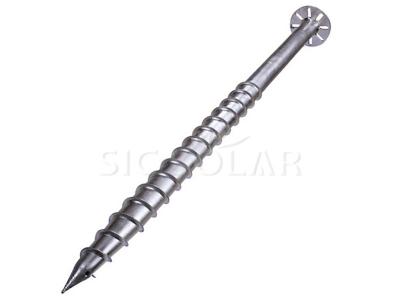
How Ground Screws Work
Installation happens by rotation, not by hammering. Solar applications generally use tubular members with welded flighting of a defined pitch. Compression and uplift both transfer through the embedded screw surfaces and the shaft. Reaching the required depth depends on soil resistance, buried obstructions, and available torque. Two limits apply: one set by the machine and one by the torsional capacity of the shaft itself.
|
Component / Design Feature |
Description & Function |
|---|---|
|
Material (high-strength steel alloys) |
Galvanized or anti-corrosive coated to resist rust; affects load-bearing capacity and lifespan |
|
Stainless steel variant |
Higher corrosion resistance for highly corrosive soils or near saltwater |
|
Thread design |
Coarse threads for softer soils; finer threads for harder, compact soils |
|
Length and diameter |
Longer screws give deeper anchorage; larger diameters increase soil contact area |
|
Multiple helixes |
Distribute load more evenly for load-bearing solar applications |
|
Adjustable heads |
Allow panel alignment on uneven terrain |
|
Specialized tips (rock anchors) |
Penetrate hard surfaces and bedrock |
Contractors use hydraulic drives mounted on excavators or dedicated rigs with leveling controls. Ground screws require low speed and high torque because their conical shape compacts soil during driving. SIC SOLAR's solar mounting system exemplifies a durable, easy-to-install solution. It is backed by ISO9001, AS/NZS 1170, and JIS 8955:2011, with a 10-year warranty and 25-year lifetime.
Best Use Cases and Trade-Offs
Ground screws install rapidly with no concrete and minimal site disturbance. They suit noise-restricted sites, agrivoltaic systems, and temporary installations. A helical pile can be extracted and reused, which restores the land. Utility-scale projects with schedule pressure benefit too: crews install 600 screws per day with two rigs, avoiding concrete cure delays. Ground mounted solar systems on soft or variable soil also favor screw piles, since deeper embedment and different helix configurations compensate for low resistance. The trade-off is cost and lateral stiffness. Screw piles cost about 26% more per point than driven piles, and tube sections provide less lateral stiffness than H-piles. On rocky ground, pre-drilling may be required.
What Are Driven Piles?
Driven piles are deep foundation elements that workers hammer or vibrate into the ground. A pile driver strikes the pile top repeatedly, forcing it through soft layers until it reaches stable soil or rock. This displacement method compacts the surrounding earth, which improves stability. Vibratory driving offers a faster, quieter alternative for softer soils. The table below summarizes the main pile materials.
|
Pile Type |
Key Characteristics |
Typical Use Case |
|---|---|---|
|
Steel |
High strength-to-weight ratio; galvanized for corrosion resistance |
Most common for solar farms in moist or saline environments |
|
Concrete |
Excellent compression resistance; customizable shape |
Projects with substantial load requirements |
|
Composite |
Combines steel and concrete advantages; minimal settlement |
Environments demanding superior performance |
|
Timber |
Limited to smaller installations; sustainable where available |
Low-impact or environmentally sensitive projects |
How Driven Piles Work
Installation relies on impact or vibratory hammers. Impact driving suits dense or compact soils but generates significant noise and vibration. Vibratory driving applies rapid oscillations to reduce soil friction, allowing the pile to sink faster and quieter. Press-in piling uses hydraulic pressure for minimal noise, ideal for urban areas. Each method displaces soil rather than removing it. This contrasts with screw piles, which crews turn into the ground like a screw. A ground-mounted solar project on standard soil often favors driven piles because they reach load-bearing capacity immediately after installation.
Best Use Cases and Trade-Offs
Driven piles are generally the cheapest foundation for medium-to-large solar projects on standard soil. Utility-scale farms above 5 MWp on flat terrain achieve the lowest cost per foundation of all non-ballasted types. Crews install 300 to 500 piles per day per rig. Projects with tight deadlines benefit because no concrete curing time is required. However, driven piles have limitations. Noise and vibration can disrupt populated areas. Very dense soils, hard rock, or boulders hinder installation. Material damage to concrete or timber piles requires careful quality control. On rocky or uneven ground, screw piles often provide a more reliable solution. A solar project manager should weigh these trade-offs against site conditions before committing.
Ground Screws vs Driven Piles: Key Differences
Comparison Table
The ground screws vs driven piles decision becomes clearer when engineers compare hard numbers side by side. The table below summarizes the key differences across cost, speed, soil suitability, and site disturbance.
|
Factor |
Driven Piles |
Ground Screws |
|---|---|---|
|
Cost per point |
$75–200 |
$100–250 |
|
Install speed |
300–500 piles per day per rig |
40% more per day than driven piles |
|
Soil suitability |
Soft, uniform ground |
Rocky, variable, sensitive soils |
|
Site disturbance |
High noise and vibration |
Low noise, minimal soil displacement |
Ground screws cost about 26% more per point than driven piles. However, crews achieve 40% more ground installation per day with screw piles. This installation speed comparison matters on tight schedules. Ground screws can also be up to 10x faster than concrete piers, which require multi-day curing before racking can begin. For a concrete foundation for solar mounting, crews must wait days before the structure becomes load-bearing. A ground screw foundation is instantly ready.
Other foundation options exist. Ballasted systems cost $200–400 per point. Earth anchors cost $150–300 per point. These alternatives suit specific site conditions, but ground screws and driven piles remain the primary choices for most solar mounting projects.
Performance on Rocky Sites
Rocky sites expose the biggest weakness of driven piles: refusal risk. When a pile hammer strikes a boulder or hardpan layer, the pile stops advancing. Each refusal forces a decision. Crews can attempt pre-drilling, which is slow and expensive, or move the pile location, which compromises the array layout. On a 5 MW solar farm with dense cobble and shallow bedrock, the refusal rate exceeded 40% during the first week. The project fell behind schedule within days. Costs escalated from wasted labor, damaged materials, and equipment downtime. After switching to screw piles for the remaining 80% of foundations, installation became immediately more efficient.
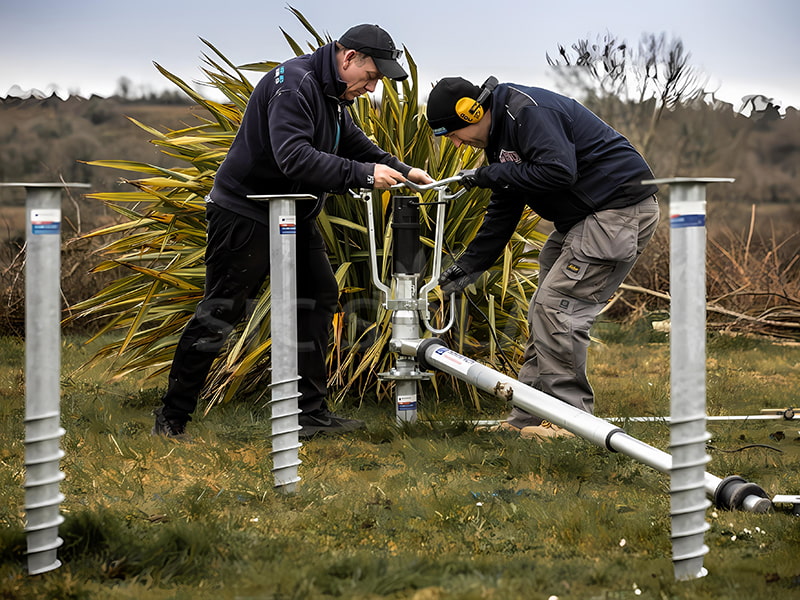
Studies show that while ground screws may cost more upfront, driven piles can quickly become more expensive when refusal rates are high. One analysis found that at a 29% refusal rate, screw piles become the more cost-effective option from an installation perspective.
This 29% threshold provides a practical benchmark. Below this refusal rate, driven piles are more economical on flat, consistent soil. Above 29% refusal probability, screw piles become the better choice. Sites with shallow rock, hardpan layers, or highly variable soil profiles fall into this category.
The structural performance comparison also favors screw piles on uneven terrain. Driven piles develop capacity through dynamic soil densification during impact driving. This mechanism works well in loose sands but provides unpredictable results on rocky ground. Ground screws develop capacity through static bearing at the helical plate. Engineers can predict this capacity from soil investigation data and verify it in real time through continuous torque monitoring. For any solar foundation system comparison hub, this predictability makes screw piles the more reliable solution on rocky or uneven ground.
A Decision Framework for Your Site
Step-by-Step Selection Guide
A structured decision process prevents costly foundation mistakes. Engineers can follow these steps to narrow the choice between ground screws and driven piles.
-
Check the rocks. If the site is rocky or full of boulders, start with concrete or pre-drilled pile solutions. Otherwise, continue to step two.
-
Check restrictions. If strict noise or vibration limits apply, consider ground screws or concrete. Otherwise, continue to step three.
-
Prioritize speed. If the deadline is tight, driven piles are the best bet. Ground screws may also work. Otherwise, continue to step four.
-
Evaluate excavation. If spoil removal is difficult or expensive, avoid concrete and choose piles or screws.
-
Validate with engineering. Finalize the choice with pull-out tests and load calculations.
This sequence keeps the solar project grounded in site realities. A ground screw foundation often wins on rocky sites because refusal risk disappears. Driven piles dominate on soft, uniform ground where speed and cost matter most.
When to Mix or Reconsider
Not every project fits one foundation type. Several conditions signal that mixing foundation methods or redesigning the array makes sense.
-
A project should consider redesigning the solar array layout or switching foundation types when the required ballast weight exceeds the roof's structural allowance. System redesign is required before procurement in that case.
-
Most project redesigns, scope reductions, or foundation type changes in commercial and industrial solar stem from ballast weight exceeding the roof structural reserve. A building structural engineer's review often discovers this constraint late in development.
-
The foundation selection guide defines threshold conditions under which penetrating or low-ballast alternatives become the structurally preferred option. These conditions indicate when a foundation type change should be considered.
-
Roof structural reserve capacity is typically the binding constraint at most commercial buildings. Confirmation by the structural engineer of record is the single most common cause of project redesign or foundation type change.
A pilot test before full commitment protects the schedule on challenging sites. Crews install a small number of screw piles or driven piles and measure torque, pull-out resistance, and installation time. The data confirms whether the chosen solar mounting foundation performs as predicted. If results fall short, the team can adjust depth, helix configuration, or switch to an alternative before ordering thousands of units.
Mixing foundation types also works on sites with variable soil. One section may feature shallow bedrock while another holds deep clay. Engineers can specify screw piles for the rocky zone and driven piles for the soft zone. This hybrid approach optimizes cost without compromising structural integrity. The key is early geotechnical data and a willingness to adapt the design.
Cost, Speed, and Long-Term Reliability
Upfront Cost and Installation Speed
Upfront pricing separates these two foundation types clearly. The table below compares cost per watt and cost per megawatt for each option.
|
Foundation Type |
Upfront Cost ($/W) |
Cost per MW (Est.) |
Key Cost Driver |
|---|---|---|---|
|
Driven Pile (Standard) |
$0.02 – $0.04 |
$20,000 – $40,000 |
Refusal / Bedrock |
|
Ground Screw / Helical |
$0.03 – $0.06 |
$30,000 – $60,000 |
Material Fabrication |
Ground screws carry a higher baseline material cost from specialized steel fabrication, including welded continuous flighting and hot-dip galvanizing. This creates an upfront premium of roughly $0.015/W over driven piles. However, this premium acts as insurance against field delays in cobble or dense soils. Driven posts offer lower upfront material cost but carry higher risk of extra costs from pile refusals. Screw piles cost more initially but deliver more predictable total installation cost. At a 29% refusal rate, screw piles become the more cost-effective option from an installation perspective. The lower upfront cost of driven piles can be offset by refusal-related expenses.
Installation speed favors ground screws on challenging sites. Crews achieve 40% more ground installation per day with screw piles compared to driven piles. This speed advantage reduces labor costs and shortens project timelines. For any solar mounting project, the total cost of installation depends on both material pricing and field productivity.
Durability and Service Life
Long-term reliability shapes the true foundation value. A lifecycle cost analysis must account for maintenance, corrosion resistance, and service life. Hot-dip galvanized steel provides excellent corrosion protection for both foundation types. SIC SOLAR's solar mounting system sets a quality benchmark with a 10-year warranty and 25-year lifetime. This standard reflects rigorous testing under ISO9001, AS/NZS 1170, and JIS 8955:2011. Structural strength and load-bearing capacity remain stable over decades when engineers specify proper corrosion protection.
The trade-offs remain balanced. A concrete solar foundation offers high mass but requires curing time and creates site disturbance. Ground screws and driven piles both avoid concrete. Screw piles allow extraction and reuse, which supports land restoration. Driven piles reach load-bearing capacity immediately after installation. Neither option wins universally. The right choice depends on soil conditions, schedule pressure, and long-term performance goals. Engineers should weigh upfront savings against refusal risk and maintenance needs. A solar foundation cost and lifecycle optimization approach considers all these factors together.
Match the foundation to the soil, not to a default preference. Ground screws vs driven piles is a site-specific decision. Screw piles excel on rocky or variable ground and install fast with minimal disturbance. Driven piles win on soft, uniform soil and large-scale economies. Engineers should run a geotechnical assessment and pilot test before committing. Use the decision framework to shortlist the right solar mounting foundation for the next project. This approach ensures a reliable ground mounted solar foundation that fits the site and the budget.
FAQ
Which foundation works best on rocky ground?
Screw piles win on rocky sites. Their helical plates grip the soil without hammering, so refusal risk drops sharply. Driven piles often stop cold on boulders or hardpan. Engineers should pilot test before committing to a full array layout.
Can a project use both foundation types?
Yes. Variable soil profiles often justify a hybrid approach. One zone may hold shallow bedrock while another features deep clay. Engineers can specify screw piles for rocky sections and driven piles for soft ground. Early geotechnical data makes this strategy practical.
How does the water table affect the choice?
A high water table softens soil and reduces bearing capacity. Ground screws handle wet conditions well because threads lock into deeper, stable layers. Driven piles may need deeper embedment to compensate. Both options require engineering review before installation.
What does a pilot test reveal?
A pilot test measures torque, pull-out resistance, and installation time on a small number of units. The data confirms whether the chosen solar mounting foundation performs as predicted. Crews can adjust depth or helix configuration before ordering thousands of units.
Is a ground mounted solar foundation more expensive than driven piles?
Ground screws cost roughly 26% more per point upfront. However, crews install 40% more per day, and screw piles become cost-effective above a 29% refusal rate. Total installed cost often favors screws on challenging sites. The right mounting choice depends on soil conditions and schedule pressure.