Choosing a hybrid solar system means balancing your backup power needs, budget, and local utility policies. A hybrid system connects to the grid and adds battery storage, so you get resilience and savings at the same time. A grid-tied setup skips the battery. An off-grid setup skips the grid. Outages are common: 28.3% of homeowners reported one in the past 12 months, and the national average lasts about 6 hours. That makes battery backup worth weighing. GREENSUN designs complete hybrid solar packages with matched inverters and lithium batteries. Compare system types, weigh key factors, and size your battery carefully.
Key Takeaways
-
A hybrid solar system connects to the grid and includes a battery. This gives you backup power during outages and saves money on electricity.
-
Check your local net metering rules and how often your power goes out. These factors decide if a hybrid system is worth the extra cost.
-
Size your battery based on your daily energy use. List your essential appliances and calculate their watt-hours to find the right capacity.
-
Make sure your inverter and battery are compatible. They must match in voltage and communication protocol to work safely and efficiently.
-
Hybrid systems cost more upfront than grid-tied systems. They pay off over time through backup power and savings, especially where outages are common.
How to Choose Hybrid Solar System Type
Grid-Tied vs. Off-Grid vs. Hybrid
Start with the three architectures. Each one changes your costs and your capabilities in a different way.
| System Type | Cost Characteristics | Functionality Characteristics |
|---|---|---|
| Grid-Tied | Lowest installation cost — no battery banks or charge controllers required | Connected to and dependent on the utility grid; uses two-way/net metering to earn credits for excess energy; no battery storage, so no backup power during outages; relies on grid at night/cloudy periods |
| Off-Grid | Significantly higher upfront cost due to required battery storage (BESS); regular battery maintenance adds ongoing cost | Operates independently of the grid; requires battery storage for nighttime/low-sunlight periods; must be carefully sized to meet all energy needs; users must closely monitor consumption; no net metering |
| Hybrid | Generally costs more than grid-tied (panels, inverter, two-way meter, battery bank, transfer means) but less than a fully off-grid setup | Combines grid connection with battery storage; offers backup power during outages (often via automatic transfer switch); still benefits from net metering and grid support |
"While both types of solar panel systems require many of the same basic components, grid-tied systems are less costly to install, mainly because they don't include battery banks or charge controllers... A hybrid system sits between the two — it stays connected to the power grid but also includes battery storage, giving users backup power during grid outages while still benefiting from net metering and lower installation costs than a fully off-grid setup."
That middle position explains why so many homeowners choose hybrid solar system designs. A hybrid solar system combines panels, a battery, and the grid. You keep net metering credits, and you keep the lights on when the utility fails. This balance makes hybrid solar systems ideal for areas without full retail net metering or with frequent outages. GREENSUN supplies complete hybrid solutions with matched inverters (Deye, Sungrow, Growatt) and LiFePO4 solar batteries, so you avoid mixing brands yourself.
Hybrid Solar Inverter and Battery Compatibility
Compatibility failures rarely come from low-quality parts. They come from overlooked details. Assuming all lithium batteries are interchangeable is a common mistake. Each battery has its own BMS logic. If the inverter does not support that protocol, you see inaccurate state-of-charge readings, charging inefficiencies, and unexpected shutdowns.

Voltage matching matters too. The battery's full charge and discharge window must sit inside the inverter's DC input range. Matching only nominal voltage while ignoring current limits can cause chronic undercharging or overheating. Safety features are core to compatibility as well. Without real-time BMS feedback, the inverter cannot respond to overheating, overcurrent, or voltage imbalance.
Cross-brand setups add physical hurdles. Different brands assign RS485 pins differently, and some manufacturers provide poor wiring guidance. Verify matching A/B pin definitions on both ends, set the BMS protocol to match the inverter protocol, and connect to the correct RS485 or CAN port. Firmware updates can fix protocol mismatches, but they cannot change hardware limits. Long-term reliability also requires periodic monitoring, proper ventilation, and avoiding mixed battery types or ages.
GREENSUN tests every solar inverter and battery pairing before shipment. Its lithium batteries work with most inverters on the market, including Deye, Sungrow, and Growatt. Cells come from BYD and CATL. That testing protects your storage investment across grid-tied and off-grid modes alike.
Key Factors for Hybrid Solar Systems
Location, Net Metering, and Outage Frequency
Your location shapes the math more than any product spec. Net metering rules decide how much credit you earn for excess electricity. Time-of-use rates decide when that credit is worth the most. Check your utility's tariff book before you commit.
| Factor | Mechanism | Effect on ROI / Payback |
|---|---|---|
| Net metering policies | Excess electricity sold back to the grid generates bill credits that offset costs | Rules (especially in time-of-use markets) can alter the payback period |
| Battery storage in a hybrid setup | Stores surplus solar for evening/cloudy-day use, boosting self-consumption and grid independence | Raises upfront cost but can shorten payback by 3–5 years |
Hybrid solar systems pay off best where full retail net metering is unavailable. You keep grid credits, and the pack covers the gaps. Read the fine print on credit rates and rollover rules.
Outage frequency sets the value of resilience. Battery storage value depends on several personal factors:
-
household goals
-
electricity rates
-
outage frequency
-
available incentives
-
the importance you place on keeping essential loads powered
Outage frequency differs by area, and even brief interruptions can cause food spoilage, lost work time, and comfort problems. Battery storage delivers resilience while also enabling tariff optimization where time-varying electricity rates exist.
If your area sees frequent interruptions, backup power moves from a nice extra to a core need. A single long power outage can justify the added cost. Homeowners who want power during outages and emergency backup often find the hybrid system worth the premium.
Budget, Incentives, and Long-Term Savings
Start with the upfront costs, then subtract incentives. Here is a realistic example for an 8kW hybrid-inverter energy storage solar system for a family of four in Texas using about 1,200 kWh per month.
| Cost Component | Amount | Notes |
|---|---|---|
| Solar Panels (8kW) | $8,000 | Premium monocrystalline |
| Inverter System | $2,400 | Hybrid inverter (battery-ready) |
| Mounting Hardware | $1,200 | Standard roof racking |
| Installation Labor | $4,800 | Professional install & electrical |
| Permits & Fees | $800 | Building permits & utility connection |
| Gross System Cost | $17,200 | Before incentives |
| Federal Tax Credit (30%) | -$5,160 | Applied following tax year |
| Net System Cost | $12,040 | After federal incentive |
Incentive rules shift often. The federal 30% Investment Tax Credit for outright purchases ended at the close of 2025. State and local incentives remain in many areas, and the DSIRE database lists them. Third-party ownership can still capture federal credits at the company level, which lowers those options.
GREENSUN keeps prices competitive through two decades of OEM experience. That scale supports reliable hardware at a fair price.
Payback speed differs by design. Grid-tied systems often reach the fastest ROI in stable grid areas. A hybrid solar system with battery excels in long-term returns through peak shaving and self-consumption. Compare those costs against long-term savings when you choose hybrid solar system equipment.
Sizing Solar Energy Storage and Battery Capacity
Calculating Solar Power Storage Battery Capacity
Sizing starts with your daily load. Build an appliance inventory first. List every device you plan to power, then note its wattage and daily hours. Multiply watts by hours for each item and add the results. Small loads add up fast, so accuracy matters.
| Appliance | Power | Hours | Energy |
|---|---|---|---|
| Lights | 50W | 6 | 300 Wh |
| Fan | 75W | 8 | 600 Wh |
| Refrigerator | 150W | 10 | 1500 Wh |
| TV | 100W | 4 | 400 Wh |
That example totals 2,800 Wh, or 2.8 kWh per day.
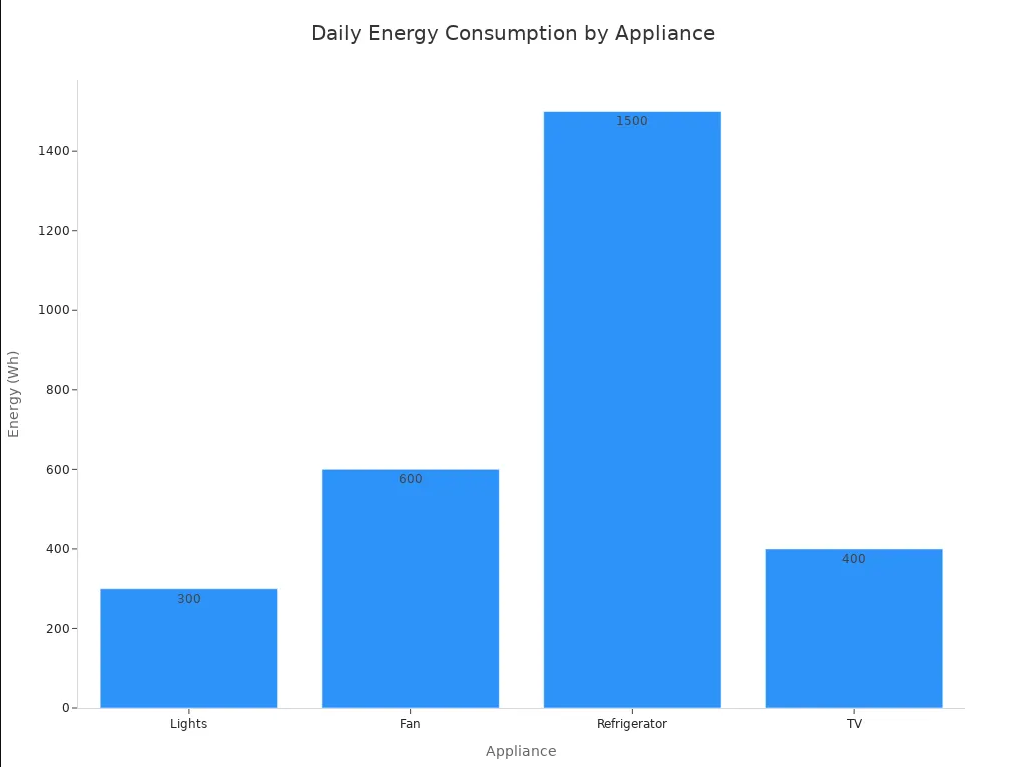
Next, convert daily load into battery capacity. Divide daily load times days of autonomy by depth of discharge times round-trip efficiency. A 2.8 kWh load with one day of autonomy, 0.8 DoD, and 0.9 efficiency needs roughly 3.9 kWh of usable capacity. Two days of backup doubles that figure. Treat the result as usable energy, not nameplate rating. Your battery needs headroom for reserve margins and end-of-life fade.
Matching Panels, Inverters, and Batteries
Panel sizing follows the same load. Divide total daily watt-hours by average sunlight hours, then add a 20–25% buffer for cloud cover, shading, and angle losses. Inverter sizing uses total watts times a factor of 1.2–1.5. Check surge ratings against the startup draw of inductive loads like air conditioners.

GREENSUN builds energy storage solar system packages around this math. Its lithium batteries pair with most inverters, including Deye, Sungrow, and Growatt. Cells come from BYD and CATL, and every unit is tested before shipment. That compatibility removes guesswork from your hybrid solar system design.
For most homeowners, hybrid solar systems offer the best balance of reliability, savings, and flexibility. This holds true in areas with unreliable grids or poor net metering. You should still choose hybrid solar system designs around your own location, budget, and backup needs. Weigh those three factors before you commit.
Consult a local installer or use GREENSUN's design services for a tailored plan. Compare quotes, calculate your daily load, and plan for future energy needs. That homework helps you pick the best solar system for your home. A well-sized hybrid solar setup with battery storage protects you from outages and rising costs. Start with your load, then let the numbers guide your choice.
FAQ
How much battery capacity does a typical home need?
Size the pack around your essential loads, not your whole house. Add up the watt-hours of the appliances you want running during an outage, then divide by depth of discharge and efficiency. Most families find one day of autonomy covers short interruptions. GREENSUN's design team can run this math for your home.
Is a hybrid solar system worth the extra money?
It depends on your utility rules and your tolerance for interruptions. A hybrid solar system shines where net metering credits are weak or the grid fails often. You pay more upfront than a grid-tied setup. You gain backup power and control over when you draw from the grid.
Can I add a battery to my existing solar setup later?
Often yes, if your inverter supports it. Check the DC input range and the communication protocol first. A solar system with battery storage needs matched voltage windows and a shared BMS language. Retrofits work best when the original inverter was chosen with expansion in mind.
Do hybrid inverters work with any lithium battery?
No. Each unit carries its own BMS protocol, and the inverter must speak it. Verify voltage range, current limits, and RS485 or CAN pin assignments before you buy. GREENSUN tests every pairing before shipment, which removes much of the guesswork from an energy storage solar system build.
What drives the long-term costs of a hybrid setup?
Upfront hardware sets the starting point. Battery replacement timing and utility rate changes shape the rest. Compare those costs against your avoided bills and the value you place on resilience. Incentives vary by state, so check the DSIRE database for programs in your area.